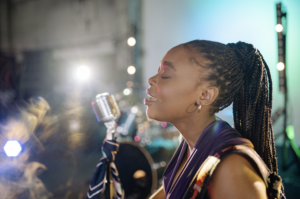
I have a hard time thinking of clients I’ve worked with – in the past and even the present – who haven’t gotten a bit emotional when singing.
And for me, a vocal coach who has seen it ALL over the years, when people get emotional I get excited because something is being released. But the real GOLD for me as a coach (and witness) is this:
It’s a beautiful experience to be with somebody who feels so safe and free to explore the emotional parts of themselves. In fact, walking my clients through this process is one of my favourite things about this work.
If you’re reading this and thinking about times when you have either held back on singing altogether because of your emotions, held back expressing your emotions while singing, or you’ve let your emotions naturally flow out of you because the dam broke and there was no holding back – I say WELCOME.
Why you actually need emotions to sing
Songs are stories that carry meaning, so of course you’re going to feel something when you sing certain words, phrases or full songs. Of course songs are going to stir up memories, images, and feelings. You’re human!
If you put yourself in the shoes of the audience for a moment, and think about the times when you’ve been most moved by a singer or performer, it’s likely because they were feeling and expressing whatever they were singing about or saying.
When I go to a show, I want to feel something. I want the artists on stage to take me on an emotional journey. And the only way they can do that is by tapping into their own emotions, which in turn creates a connection between them and their art and that connection (at the best of times) gets shared with their audience.
Without those emotions, everything would fall flat. And I’m sure you can think of shows you’ve been to where the performer was kind of “phoning it in” – but that’s a whole other blog topic ;).
My point is, when you tap into your emotions and how you feel when you sing the lyrics of your songs, you actually start to make the song your own. You connect to the story, the memories, the words and the meaning in ways that only YOU can.
And that also has a huge impact on how you then shape the song, how you sing certain lines, your phrasing, the whole vibe… and the list goes on.
It all starts with allowing yourself to sit in the emotions of your songs!
Emotions are part of your voice, plain and simple
Your emotions are not getting in the way of your singing because they ARE your singing.
I’m not saying I want you crying every single time you practice! But I do believe that to really learn how to control and harness your emotions in a song, you first have to be willing to go to a place of vulnerability. You have to let yourself feel it before you can learn to work with it.
Vulnerability is your superpower here.
So lean in and let yourself be moved. Allow yourself to shed some tears. You might not get through the whole song you’re trying to sing and that’s OK. It will get easier with time, and it will definitely connect you more deeply to the song and to your voice.
My most helpful tip for singing through tears (and ALL the feels really)
Here’s the practical part, because when the emotions hit, the first thing that goes out the window is your breath.
Your breaths become shallow and disconnected. Short little gasps instead of the deep, grounded breath you need. It can feel like you’re starting to lose control, maybe even hyperventilate a little.
In that moment, when the emotion is really welling up – when you’re feeling all the joy / panic / fear / nostalgia – try to FIND YOUR BREATH.
I’m making this sound easy and it’s not because when you’re feeling like you’re losing control it is definitely a challenge to harness your breath again.
This is where the practice comes in and why I want you allow yourself to feel all the feels. So you can also feel what it’s like to connect back to your breath. Come back to it. A deep breath, low and slow, right into your belly.
In time this will get easier, and you’ll learn how to sing through challenging passages or full on challenging songs!
Where to go from here
Come to your next practice – whether it’s a lesson or solo singing time – with a little more permission to feel whatever shows up. I want you to start seeing emotions for what they are – an open door to more connected, authentic, powerful singing.
So let yourself go there. Find your breath and keep going my friend!
And if you want to get really solid on your breath – not just when emotions hit, but every time you sing – I have a course for that! Big Bold Breath is a 4-day micro course (just 10 minutes a day!) that walks you through exactly how to find your breath, get it in deep, and use it effectively. Past clients have been surprised by how much shifts in just four days.
Check out Big Bold Breath here